
Runaway Black Holes: High-Speed Giants Tearing Through Galaxies
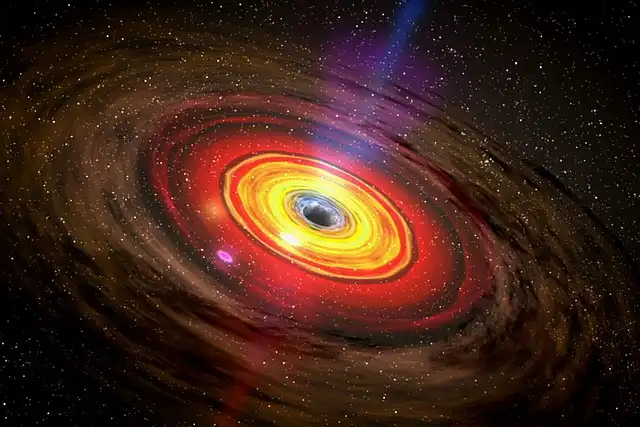
Scientists explore the phenomenon of runaway black holes kicked out of galaxies at extreme speeds. New evidence shows these giants leaving trails of stars, providing insight into gravitational waves and Einstein's theories.
For the second we need to think about Einstein’s well-known formula E = mc two which says that power has mass. In the case of a great void, Kerr’s solution tells us that as high as 29% of a black hole’s mass can be in the form of rotational energy.
A Potential Cosmic Hazard
Picture if it had been something much bigger and quicker: a black hole taking a trip at even more like 3,000 kilometres per secondly. We wouldn’t see it coming till its extreme gravitational forces started knocking around the orbits of the outer planets.
So runaway great voids tearing via and in between galaxies are a new active ingredient of our exceptional cosmos. It’s not impossible that could turn up in our planetary system, with potentially devastating results.
Last year, astronomers were fascinated by a runaway comet travelling through our solar system from somewhere much past. It was moving at around 68 kilometres per 2nd, just over double Earth’s rate around the Sun.
Gravitational Kicks and Intergalactic Travel
If these very large runaways exist, so too should their smaller relatives due to the fact that gravitational wave observations recommend that a few of them integrated with the opposing spins needed to produce powerful kicks. The rates are conveniently quickly sufficient for them to take a trip in between galaxies.
This may seem a bit ludicrous– however in the past year several lines of evidence have actually come together to show such a visitor is not impossible. Astronomers have actually seen clear signs of runaway supermassive black holes tearing with other galaxies, and have actually revealed proof that smaller, undetected runaways are possibly out there also.
They are predicted to leave contrails of celebrities in their wake, developing from interstellar gas in the same way contrails of cloud type in the wake of a jet plane. Stars form from falling down gas and dirt brought in to the passing great void. It’s a process that would certainly last for 10s of countless years as the runaway black hole crosses a galaxy.
Collision Energy and General Relativity
It took two decades of painstaking supercomputer calculations to recognize what occurs when 2 spinning black holes collide and coalesce, creating gravitational waves. Depending upon just how the great voids are spinning, the gravitational wave energy can be launched much more highly in one instructions than others– which sends out the black holes shooting like a rocket in the contrary direction.
Get in touch with me with information and offers from other Future brandsReceive email from us in behalf of our relied on partners or sponsorsBy sending your details you accept the Problems & terms and Personal privacy Plan and are aged 16 or over.
It’s easy and fast to accessibility Live Scientific research Plus, merely enter your email below. We’ll send you a verification and authorize you up for our everyday e-newsletter, keeping you approximately date with the latest scientific research news.
Tracing Star Contrails in Distant Galaxies
Another defines a lengthy straight contrail reducing throughout a galaxy called NGC3627. This one is most likely triggered by a black opening of regarding 2 million times the mass of the Sun, travelling at 300km/s.
The tale starts in the 1960s, when New Zealand mathematician Roy Kerr found a service of Einstein’s general relativity equations that defined rotating great voids. This resulted in 2 critical explorations concerning black holes.
English physicist Roger Penrose deduced 50 years ago that this rotational energy of great voids can be released. A spinning black hole is like a battery with the ability of launching huge quantities of spin power.
One more describes a long straight contrail crossing a galaxy called NGC3627. This is most likely brought on by a great void of regarding 2 million times the mass of the Sunlight, taking a trip at 300km/s. Its contrail has to do with 25,000 light years long.
James Webb Observations of Massive Wakes
One paper, led by Yale astronomer Pieter van Dokkum, defines a very distant galaxy imaged by the James Webb telescope with a remarkably brilliant contrail 200,000 light years long. The contrail showed the stress effects anticipated from the gravitational compression of gas as a black hole passes: in this instance it recommends a great void with a mass 10 million times the Sunlight’s, taking a trip at nearly 1,000 km/s.
They are forecasted to leave contrails of stars in their wake, developing from interstellar gas in the exact same way contrails of cloud form in the wake of a jet airplane. Stars form from breaking down gas and dirt brought in to the passing black opening. It’s a procedure that would last for tens of millions of years as the runaway black hole goes across a galaxy.
All this recommended runaway great voids were an actual opportunity. Moving at 1% of light speed, their trajectories via room would certainly not adhere to the bent orbits of celebrities in galaxies, however instead would certainly be virtually directly.
The Search for Undetected Runaways
It is tough to search for reasonably little runaway great voids. Yet a runaway great void of a million or billion solar masses will certainly create substantial disturbances to the stars and gas around it as it takes a trip with a galaxy.
David Blair is an emeritus teacher of physics at the University of Western Australia and participant of Australian Research study Council Centre of Quality for Gravitational Wave Exploration (OzGrav). He leads a global project aiming to present Einsteinian ideas right into institution education and learning at a very early age.
1 Astronomy Events2 black hole change
3 Einstein rings
4 gravitational waves
5 space exploration
6 supermassive black holes
« SPHEREx Telescope Uncovers Secrets of Interstellar Comet 3I/ATLASMars Mini-Lightning: Perseverance Rover Records Electrical Dust Devil Zaps »