
Canada’s Wildfires: Causes, Impacts, and Climate Change
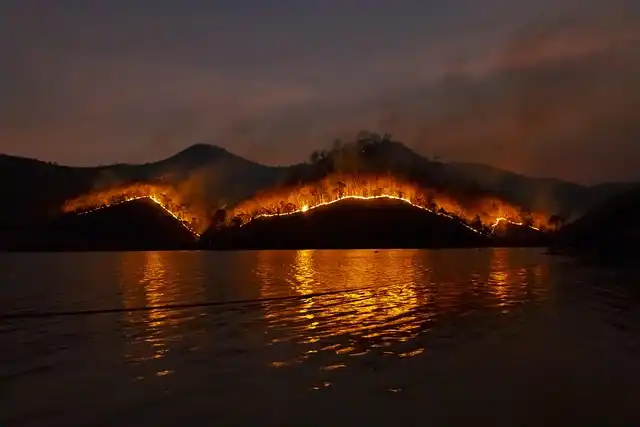
Canadian wildfires, fueled by lightning and human activity, are becoming more extreme due to climate change. These massive fires, though few, destroy vast areas and create hazardous smoke impacting air quality across North America. Fire management is increasingly challenging.
Canadian wildfires in north Ontario sent thick plumes of smoke hundreds of kilometers to the eastern and south, blanketing numerous U.S. cities in unsafe haze. Here, a NASA visualization tracks the smoke from July 14 through July 20. Darker smoke colors suggest raising smoke strength, representing worse air high quality. Bright red regions suggest energetic fires.
Yet that kind of regular monitoring would not be feasible or preferable throughout Canada’s large hinterlands, which extend some 300 million hectares. In addition, the reasoning is flawed, scientists state: Those areas have actually never been taken care of, so it does not make sense that a lack of monitoring there would certainly be accountable for the recent uptick in extreme fires.
Terminates in Canada’s boreal forests are largely fired up by lightning or by human activities: the careless throw of a cigarette butt, a stray cinder from a bonfire or a spark from a train. In regards to the straightforward variety of fires they start each year, lightning and humans are about comparable.
Severe wildfires– those that shed greater than 200,000 hectares of land– currently dominate Canada’s yearly fire stats. These leviathans are fairly couple of in number, making up simply 3 percent of the annual fires. They are responsible for 97 percent of the land melted.
The impact of smoke and warmth together is above the sum of their private results, Henderson says. When summer season smoke looms, “move to a great interior atmosphere with cleaner, cooler air, if you can.”
This snapshot of the focus of tiny particulate matter and ozone, mapped on July 17, demonstrates how the plume of wildfire smoke affected air quality in cities throughout the northeastern and northern USA. Purple shades indicate one of the most unhealthy conditions.Airnow.gov
Aerial attacks may purchase a little time by reducing the blazes, but the soil might still smolder for weeks. “If you don’t obtain the hot spots, a week later you get a huge wind event, and it’s off to the races we go,” Flannigan states. Landing crew equipped with infrared video cameras are needed to locate those locations and placed them out.
The tiny bits can lodge in the lungs or make their way to the blood stream– and because of this are linked to lung damage, increased danger of heart attack and reduced life expectancy. Years of repetitive exposure to wildfire smoke can additionally increase chances of sudden death, scientists say.
Scientific research News was started in 1921 as an independent, not-for-profit source of accurate details on the current news of scientific research, medication and technology. Today, our objective stays the same: to equip people to evaluate the information and the world around them. It is released by the Culture for Scientific research, a not-for-profit 501(c)( 3) subscription organization committed to public involvement in clinical research study and education (EIN 53-0196483).
“2023 was bonkers; it was off the graphes,” states Flannigan. That year, a document 15 million hectares– an area approximately the size of the state of Illinois– of land got on fire in Canada, starting in very early May. That overshadowed the previous record, a mere 6.9 million hectares.
However when it involves overall location burned, it’s not also shut. Lightning is by far the primary ignition resource, responsible for an estimated 92 percent of area shed– frequently in Canada’s remotest regions, where fires have a tendency to be monitored instead of combated.
Public messaging concerning fire management most likely added to a decline in human-caused fires by 2018. Extreme wildfires– those that melt even more than 200,000 hectares of land– currently control Canada’s yearly fire data.” Severe fire weather actually drives the fire globe in Canada. Fire reductions is additionally dramatically a lot more difficult with these intense fires. Typically, fire control techniques include direct aerial assaults, such as going down water, fire resistant chemicals or foams from aircrafts.
Canada’s fire managers are likewise fighting another type of wildfire: false information on social media suggesting the nation’s out-of-control fires are the outcome of poor monitoring practices. Some cases suggest reining the fires in should be a fairly straightforward matter of eliminating older, fuel-rich trees or forest flooring particles.
Fire reductions is likewise significantly much more challenging with these intense fires. Usually, fire containment methods consist of straight aerial attacks, such as going down water, fire resistant chemicals or foams from planes. Indirect attacks are next in line: exhaustion operations that shed land before where the fire is spreading with the wind, trying to rob it of fuel.
“Severe fire climate truly drives the fire globe in Canada. States as well,” claims Mike Flannigan, a wildland fire scientist at Thompson Rivers University in Kamloops, British Columbia.
A comparable scenario occurred in 2023, when smoke from a terrible, record-breaking fire year in Canada additionally turned some U.S. city skylines orange. Forecasts of future environment change suggest there will probably be much more such events.
But “when you get a really extreme fire, the tools in the fire supervisor’s tool kit beginning to decrease rapidly,” Hanes claims. “At a particular factor, fire ends up being a flooding or a storm– when it’s generating its very own weather condition, that is no longer something we can fight.”
Canada is so substantial and sparsely lived in that battling fires in its unoccupied wild is likewise not a great use of resources. Effective fire suppression commonly requires quick reaction for maximum performance, probably within the first 30 minutes after ignition. That’s much less possible for remote fires than for those in inhabited areas.
Integrate these smoky risks with heats– a situation that will possibly raise as the planet remains to heat– and mortality danger gets even greater, claims Sarah Henderson, the clinical director of ecological wellness services at the British Columbia Centre for Condition Control in Vancouver.
“The boreal forest is developed to burn; that’s exactly how it replaces itself,” claims Chelene Hanes, a wildland fire researcher with the Canadian Woodland Service who is based in Sault Ste. Marie in Ontario. “It’s environmentally responsible to let fires do what they do,” as long as they’re not threatening to influence neighborhoods, she states.
“Large fires are getting bigger, covering a larger location and burning for longer,” Hanes states. Drier landscapes likewise mean fewer wetland areas that once acted as fire breaks, and bigger fires can overlook Canada’s lots of lakes without being extinguished considerably.
As surprising as 2023 was, it belongs to a longer-term uneasy pattern. A climate attribution research study that analyzed the unusually extreme fire season in eastern Canada identified that environment adjustment greater than doubled the probability of extreme fire problems existing in the area.
And 2023, 2024 and 2025 were all huge fire years, the first time on document that there were three in a row, Flannigan says. “2026 was a litmus examination: Will we see one more energetic fire season in Canada? We can probably expect one every year, since of our altering climate.”
Public messaging concerning fire management probably added to a decrease in human-caused fires by 2018. Recent information suggest that human-caused fires are once again on the increase.
“Extreme” in fire terminology refers particularly to big shed areas– but such massive fires can also be incredibly intense, melting so warm that they generate their very own weather condition. The heat climbing from these fires high right into the atmosphere is increasingly likely to develop pyrocumulus clouds, fire electrical storms that consequently can spawn a lot more lightning and spark new fires.
We go to a critical time and sustaining environment journalism is more crucial than ever before. Science News and our parent company, the Culture for Scientific research, require your help to reinforce ecological proficiency and make certain that our action to environment modification is notified by science.
Canada is on fire. Over 190 wildfires surging in Ontario in July have until now melted greater than 735,000 hectares of boreal, or subarctic, woodland. And the thick smoke from those blazes smothered the united state Midwest and East Coastline for days with thick plumes of dangerous haze.
Canada is heating at about twice the international rate, with longer, hotter summer seasons and earlier snowmelt. A warmer atmosphere a lot more rapidly draws dampness out of dead gas in the woodland floor or from soils. Shifts in the North Hemisphere jet stream are lowering rainfall too. And warmer wintertimes are expanding the varieties of ache bark beetles that kill trees. Every one of this implies even more fuel available to shed.
“We’re seeing a growing number of these fools,” Flannigan claims. “They have always been about, yet the sheer varieties of them are enhancing.” The 2023 Canadian wildfire period, for instance, had one of the most fire-generated thunderstorms on document, at over 140; the previous record was embeded in 2021, with 100.
1 air quality2 boreal forest
3 climate change
4 fire management
5 Waterloo in Canada
6 wildfires
« The Quest for the Roundest Animal: Why True Spheres are RareDr. Selwyn Rogers Jr. on Tackling Gun Violence as a Public Health Crisis in Chicago »