
Arctic Eclipse Illusion: Why the Shadow Appears to Reverse Course
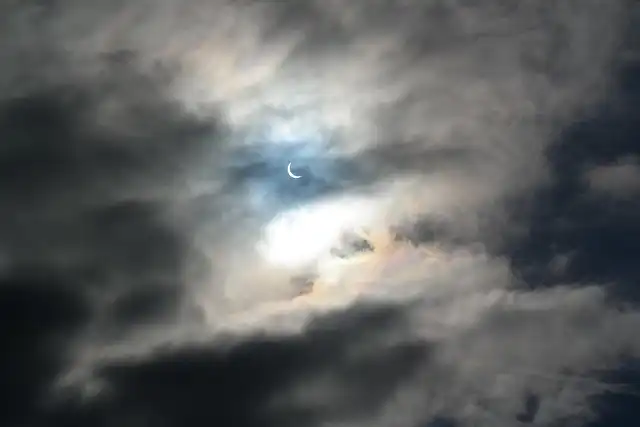
Discover why the Arctic solar eclipse path seems to reverse, a visual trick of flat maps and Earth's rotation. Learn about umbra and penumbra, and the true west-to-east path of the moon's shadow.
Understanding the Moon’s Shadow
This triggers the darkness to sweep over the Arctic in a broad contour, rather than following the more acquainted west-to-east path. On a flat map, that bent course can make it look as though the eclipse briefly turns around instructions, even though it never actually does.
The moon’s shadow has 2 components– the slim umbra, where viewers experience completeness, and the much wider penumbra, where only a partial eclipse shows up. The sizes of these shadows depend upon the moon’s range from Earth, while their speed is affected by the moon’s orbit, Planet’s rotation and the geometry of the eclipse.
“The path of this eclipse additionally has a solid north-south part, the mixed impact of Earth’s turning and the tilt of both Planet’s axis and the Moon’s orbit,” specialists at NASA’s Scientific Visualization Studio described. “Incorporated with Earth’s rotation, the umbra’s eastern movement during the first fifty percent of its traveling is properly canceled out.”
The Illusion of Reversal
The moon’s shadow follows a smooth arc across Earth’s bent surface and never changes direction, as revealed by this computer animation.
The evident reversal from Siberia to Greenland is an illusion. It’s developed by geometry, however it’s additionally an outcome of watching the eclipse on a flat map rather than on a globe. The moon’s darkness adheres to a smooth arc across Earth’s curved surface area and never adjustments direction, as revealed by this animation. This eclipse passes so near the North Pole that the distortion triggered by map projections makes the track appear to bend back on itself, when in reality, the shadow is just sweeping over the top of the world.
Jamie Carter is a Cardiff, U.K.-based freelance science reporter and a regular contributor to Live Science. He is the writer of A Stargazing Program For Beginners and co-author of The Eclipse Effect, and leads international stargazing and eclipse-chasing excursions. His job appears routinely in Space.com, Forbes, New Researcher, BBC Sky at Night, Sky & Telescope, and other significant science and astronomy magazines. He is additionally the editor of WhenIsTheNextEclipse.com.
The Science Behind the Path
If you have actually looked at maps of the Aug. 12, 2026, overall solar eclipse, you may have noticed something confusing. In the beginning glance, the eclipse appears to do the exact reverse. The path seems to begin in far northern Siberia, near the North Post, prior to heading toward eastern Greenland, making it look as though the moon’s shadow were traveling from east to west. It after that appears to curve over western Iceland and northern Spain. What’s going on?
Every total solar eclipse travels from west to east, because the moon and Planet move in the very same direction– counterclockwise, or from west to eastern. Earth revolves eastward when every 24 hours, and the moon likewise travels eastward as it orbits our earth. Due to the fact that the moon’s shadow moves across Earth faster than the world turns below it, the path of totality (the course of the moon’s umbra, the darkest component of its internal shadow) constantly brushes up from west to eastern.
Fear not if you aren’t in the best area for the overall solar eclipse. A near-total lunar eclipse will certainly be visible over the majority of North America just two weeks later on, and there are lots of other summertime skywatching highlights to expect.
Every total solar eclipse takes a trip from west to eastern, because the moon and Earth move in the very same instructions– counterclockwise, or from west to eastern. Planet revolves eastward once every 24 hours, and the moon also takes a trip eastward as it orbits our earth. Because the moon’s darkness relocates across Earth faster than the world revolves under it, the course of totality (the route of the moon’s umbra, the darkest part of its inner darkness) constantly brushes up from west to east.
Get in touch with me with information and supplies from other Future brandsReceive e-mail from us in behalf of our relied on partners or sponsorsBy submitting your details you accept the Terms & Problems and Personal privacy Plan and are aged 16 or over.
1 Antarctic eddies2 Astronomy Events
3 celestial mechanics
4 map projection
5 moon shadow
6 Total Solar Eclipse
« LatAm-FINGERS: Tailored Lifestyle Interventions Boost Dementia Prevention HopesMagnetoelastic Tent: Smart Fabric Harvests Energy for Off-Grid Power »